Tissue Repair & Longevity

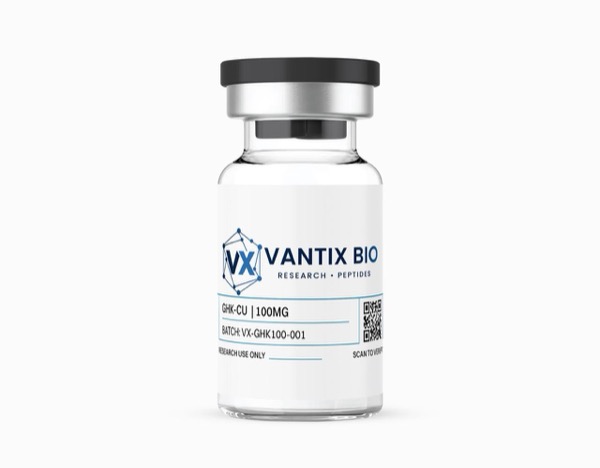
GHK-Cu 100mg

$42
COA Verified
A copper-coordinated tripeptide that modulates 4,000+ genes—nature's master regulator of extracellular matrix remodeling, tissue repair, and antioxidant defense.
GHK-Cu 100mg - Vantix Bio
FormLyophilized Powder
Quantity100mg
Purity≥98% (HPLC Verified)
SequenceGly-His-Lys:Cu(II)
CAS Number49557-75-7
Molecular Weight403.9 g/mol (copper complex)
Molecular FormulaC14H23CuN6O4
Storage-20°C (lyophilized) / 2-8°C (reconstituted)
Third-Party Tested
Next Business Day Ship
Free Shipping $150+

Analytical Specifications

PURITY (HPLC)
≥98%
MOLECULAR WEIGHT
404.0 g/mol
CAS NUMBER
49557-75-7
BATCH ID
VX-GHK100-001
Verified by Janoshik Analytical: HPLC + LC-MS/MS + LAL Endotoxin
Quantity:
1
Verify COA

What is GHK-Cu?

Glycyl-L-Histidyl-L-Lysine bound to copper(II) represents one of nature's most elegant metal-mediated signaling systems. First isolated from human plasma in the 1970s by Dr. Loren Pickart at the University of Washington, GHK-Cu demonstrated that a remarkably simple tripeptide—when precisely coordinated with a copper ion—could orchestrate complex biological responses including collagen synthesis, wound healing, and gene expression modulation on a scale rarely seen with larger, more complex molecules.

The copper ion, positioned by the peptide's histidine imidazole nitrogen and the terminal glycine amino group in a square planar coordination geometry, activates the complex's biological functions through both direct catalytic activity and signaling pathway modulation. GHK-Cu stimulates collagen and glycosaminoglycan synthesis, regulates metalloproteinase activity for balanced extracellular matrix (ECM) remodeling, provides localized antioxidant effects through superoxide dismutase-mimetic copper chemistry, and modulates expression of over 4,000 human genes—representing approximately 31% of the transcriptome.

GHK-Cu plasma concentration declines significantly with age: from approximately 200 ng/mL at age 20 to 80 ng/mL by age 60. This decline correlates with diminished tissue repair capacity, thinning skin, reduced wound healing rates, and increased fibrosis—a relationship that has driven extensive research into GHK-Cu's role in regenerative medicine, dermal remodeling, and age-related tissue degeneration. The 100mg research format provides abundant material for comprehensive in vitro and in vivo studies.

Mechanism of Action

GHK-Cu functions through multiple interconnected mechanisms centered on the copper(II) ion's catalytic and signaling properties. The tripeptide chelates Cu(II) through nitrogen atoms from the glycine amino terminus, histidine imidazole ring, and deprotonated amide nitrogen, creating a thermodynamically stable square planar coordination complex. This copper-peptide architecture serves as a signaling molecule that modulates gene expression—genomic studies demonstrate GHK-Cu regulates over 4,000 genes, with particularly strong effects on extracellular matrix proteins (collagens I, III, IV), matrix remodeling enzymes (MMPs and TIMPs), and antioxidant defense enzymes (SOD, catalase).

The peptide stimulates fibroblast proliferation through activation of ERK1/2 and Akt signaling pathways while enhancing TGF-β secretion to drive collagen synthesis. Remarkably, GHK-Cu demonstrates phase-dependent MMP regulation: it upregulates MMP-2 during early wound healing to clear damaged extracellular matrix, then suppresses excessive MMP activity during the remodeling phase to prevent matrix degradation—a sophisticated temporal regulation that promotes organized tissue repair rather than scar formation.

The copper center provides localized antioxidant effects through catalytic conversion of superoxide radicals (SOD-mimetic activity) and may facilitate copper delivery to copper-dependent enzymes including lysyl oxidase (essential for collagen cross-linking) and tyrosinase (involved in melanogenesis). In keratinocytes, GHK-Cu increases production of decorin—a small leucine-rich proteoglycan that regulates collagen fibril assembly, ensuring organized rather than disorganized collagen deposition.

Genomic Reprogramming and Senescence-Related Signatures

The breadth of GHK-Cu's transcriptomic influence—modulating over 4,000 human genes—has been confirmed through comprehensive microarray and RNA-seq analyses. Remarkably, the pattern of gene expression changes produced by GHK-Cu treatment in aged cells closely resembles the gene expression profile of young, healthy cells. The peptide upregulates genes associated with tissue repair, antioxidant defense, and organized matrix remodeling, while simultaneously downregulating genes associated with inflammation, fibrosis, and tissue degradation. This bidirectional transcriptomic shift has been described as a "genomic reset" toward a more youthful expression pattern.

Specific gene networks affected include the TGF-β superfamily (driving collagen synthesis and tissue remodeling), the Wnt/β-catenin pathway (regulating cell proliferation and stem cell maintenance), and the Nrf2/Keap1 antioxidant response system (enhancing cellular defense against oxidative stress). GHK-Cu also suppresses expression of pro-inflammatory genes including multiple interleukin and TNF family members, NF-κB pathway components, and inflammatory matrix metalloproteinases (MMP-1, MMP-3, MMP-13) while preserving expression of tissue-remodeling MMPs (MMP-2) required for organized repair.

The practical implication for researchers is that GHK-Cu operates as a broad-spectrum tissue remodeling signal rather than a single-pathway drug. Studies employing GHK-Cu should account for its extensive transcriptomic effects when interpreting results—what appears to be a simple collagen synthesis experiment may also involve changes in antioxidant defense, inflammatory signaling, and stem cell activation that contribute to observed outcomes. This breadth of action, while complicating mechanistic dissection, also makes GHK-Cu uniquely valuable for studying integrated tissue repair responses where multiple pathways must coordinate for successful healing.

Key Research Findings

Research Applications

Published Research Protocols

Published protocols describe reconstitution with bacteriostatic water or appropriate buffer. GHK-Cu is highly soluble and stable in aqueous solution. In vitro studies typically use 1-10 μM for fibroblast and keratinocyte assays. In vivo topical studies use 0.01-0.1% solutions. Parenteral dosing in rodent models ranges from 0.5-4 mg/kg.

Storage & Handling

Store lyophilized at -20°C protected from light—copper complexes are photosensitive and may undergo photoreduction. Reconstitute with sterile water or bacteriostatic water; the copper complex remains stable at 2-8°C for 30 days. Avoid oxidizing agents and strongly alkaline solutions which may disrupt the copper coordination. The characteristic blue-green color of the reconstituted solution confirms intact copper(II) coordination.

Wound Healing Applications and Clinical Relevance

GHK-Cu's wound healing effects have been characterized in multiple preclinical and clinical research models. In diabetic wound models—where healing is significantly impaired by hyperglycemia-induced vascular dysfunction and chronic inflammation—GHK-Cu treatment restores healing rates to near-normal levels through combined angiogenic, anti-inflammatory, and matrix-remodeling activities. The peptide's ability to coordinate these multiple repair pathways simultaneously addresses the multi-factorial nature of impaired diabetic wound healing more comprehensively than single-pathway interventions.

The anti-scarring properties of GHK-Cu merit particular attention. Scar formation results from disorganized collagen deposition, excessive myofibroblast activity, and insufficient matrix remodeling. GHK-Cu addresses all three: it promotes organized collagen fibril assembly through increased decorin expression, suppresses excessive myofibroblast differentiation through TGF-β pathway modulation, and enhances controlled matrix remodeling through balanced MMP/TIMP regulation. The resulting tissue more closely resembles native architecture than the dense, disorganized scar tissue produced by unassisted healing—a finding with significant implications for surgical and dermatological research.

In aging skin models, GHK-Cu demonstrates remarkable reversal of age-associated changes. Treatment increases dermal collagen density, reduces fine line depth through enhanced glycosaminoglycan synthesis (which hydrates the extracellular matrix), and improves skin elasticity through promotion of organized elastin fiber networks. These cosmeceutical applications, while distinct from medical wound healing research, share the same underlying molecular mechanisms—making GHK-Cu a versatile research tool bridging regenerative medicine and dermal aging biology. The 100mg format supports both in vitro mechanistic studies and topical formulation development programs.

Frequently Asked Questions

What makes GHK-Cu unique among tissue repair compounds?

GHK-Cu modulates over 4,000 genes—roughly 31% of the human transcriptome—through a single tripeptide-copper complex. Its phase-dependent regulation of matrix metalloproteinases (upregulating early, suppressing late) promotes organized tissue repair rather than scar formation, a sophistication unmatched by other repair compounds.

How can such a small molecule affect so many genes?

The copper(II) center enables GHK-Cu to interact with multiple cellular receptors and signaling cascades simultaneously, including ERK1/2, Akt, TGF-β, and Nrf2 pathways. This multi-pathway activation creates a broad transcriptomic response from a minimal molecular scaffold.

What reconstitution methods are described in published literature for GHK-Cu?

Add bacteriostatic water slowly. GHK-Cu dissolves quickly and completely—the resulting solution should have a faint blue-green tint confirming intact copper coordination. If the solution is colorless, copper may have been lost.

What purity testing is performed?

Dual HPLC verification (manufacturer + independent lab) plus elemental analysis confirming copper content. COAs available at our verification portal.

Why the 100mg format?

GHK-Cu is used at higher concentrations than most peptides (micromolar range vs. nanomolar). The 100mg format provides cost-effective material for comprehensive dose-response studies, extended cell culture experiments, or formulation development.

Is the copper content standardized?

Yes. Each batch is verified to contain stoichiometric Cu(II) in the correct coordination geometry. The 1:1 peptide:copper ratio is confirmed by elemental analysis and UV-Vis spectroscopy.

References

  1. Pickart L, et al. "GHK and DNA: Resetting the Human Genome to Health." Biomed Res Int. 2014;2014:151479. PMID: 25197663
  2. Simeon A, et al. "Expression of metalloproteinases in human keratinocytes." Ann Dermatol Venereol. 2001;128(3):352-357. PMID: 11319321
  3. Mulder GD, et al. "Enhanced healing of ulcers in patients with diabetes by topical treatment with GHK-Cu." Wound Repair Regen. 1994;2(4):259-269. PMID: 17156118
  4. Pickart L. "The human tri-peptide GHK and tissue remodeling." J Biomater Sci Polym Ed. 2008;19(8):969-988. PMID: 18644225
FOR RESEARCH PURPOSES ONLY. This product is intended exclusively for in vitro laboratory research and is not for human consumption, diagnostic use, or therapeutic applications. By purchasing, you certify you are a qualified researcher.
GHK-Cu 100mg
$32