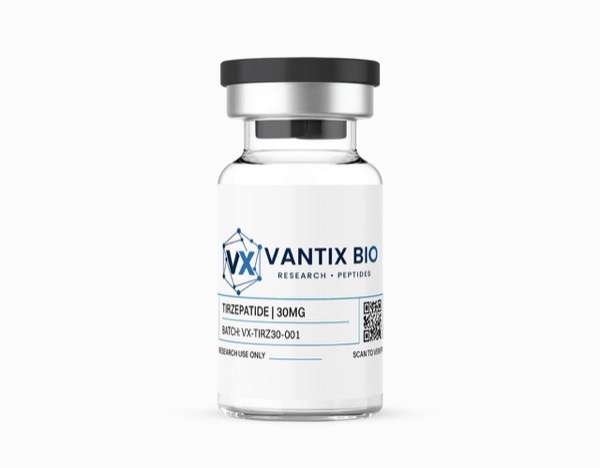
Tirzepatide 30mg
| Form | Lyophilized Powder |
| Quantity | 30mg |
| Purity | ≥98% (HPLC Verified) |
| CAS Number | 2023788-19-2 |
| Molecular Weight | 4813.5 g/mol |
| Storage | -20°C (lyophilized) / 2-8°C (reconstituted) |
What is Tirzepatide?
Tirzepatide represents a paradigm shift in incretin biology—the first molecule to achieve balanced, simultaneous activation of both glucose-dependent insulinotropic polypeptide (GIP) and glucagon-like peptide-1 (GLP-1) receptors within a single peptide chain. Where previous research focused exclusively on single-receptor agonism, scientists engineered this novel 39-amino acid peptide based on the native GIP sequence with strategic modifications that confer potent GLP-1 receptor activity, creating a dual agonist profile impossible to replicate with natural hormones or combinations of single-target agents.
This dual incretin activation reveals synergistic metabolic effects that fundamentally exceed what either pathway achieves alone. GIP receptor engagement enhances insulin secretion from pancreatic beta cells and appears to support beta-cell health through anti-apoptotic signaling, while simultaneously improving insulin sensitivity in adipose tissue. GLP-1 receptor activation provides complementary anorexigenic signaling through hypothalamic neuron modulation and delays gastric emptying. The convergence of these pathways creates metabolic improvements that surpass the sum of their individual contributions—a phenomenon researchers are only beginning to fully characterize.
For investigators studying incretin receptor cross-talk, synergistic metabolic signaling cascades, or the distinct yet complementary contributions of GIP versus GLP-1 pathways, tirzepatide has become an indispensable pharmacological tool. Its 30mg format provides sufficient material for comprehensive research programs exploring dose-response relationships across both receptor systems.
Mechanism of Action
Tirzepatide operates as a unimolecular dual agonist, binding both GIP and GLP-1 receptors with carefully balanced potencies (EC50 of approximately 0.05 nM for GIP-R and 0.2 nM for GLP-1R). This balanced affinity profile was deliberately engineered—not an incidental property—through systematic structure-activity relationship studies that optimized dual receptor engagement.
At the GIP receptor, predominantly expressed on pancreatic beta cells and adipocytes, tirzepatide stimulates insulin secretion through Gαs-coupled cAMP elevation and may enhance beta-cell survival through anti-apoptotic signaling cascades involving Akt phosphorylation. Simultaneously, GLP-1 receptor activation provides complementary metabolic effects: enhanced glucose-dependent insulin secretion, suppression of inappropriate glucagon release from alpha cells, delayed gastric emptying through vagal afferent signaling, and reduced appetite through effects on hypothalamic POMC and AgRP neurons.
The dual receptor activation creates synergistic metabolic effects that exceed simple additive responses—a phenomenon termed "incretin synergy." GIP receptor engagement appears to uniquely enhance insulin sensitivity in adipose tissue, promoting healthy lipid storage and reducing ectopic fat deposition, while GLP-1 receptor activity drives the potent appetite-suppressive effects. The C20 fatty acid modification at lysine-20 enables albumin binding similar to semaglutide, providing sustained drug exposure with an elimination half-life approaching 5 days and enabling once-weekly dosing while maintaining both GIP and GLP-1 receptor engagement throughout the entire dosing interval.
Incretin Synergy: Beyond Additive Effects
The concept of "incretin synergy" central to tirzepatide's mechanism deserves deeper examination. When GIP and GLP-1 receptors are activated simultaneously, the resulting metabolic effects exceed what mathematical addition of individual receptor responses would predict. This synergy arises from convergent intracellular signaling: both receptors couple to Gαs proteins, but their downstream effectors interact at multiple nodes. GIP receptor activation enhances β-arrestin recruitment at GLP-1 receptors, potentially prolonging GLP-1R signaling duration. Simultaneously, GLP-1 receptor activation appears to sensitize adipocyte GIP receptors, amplifying GIP's insulin-sensitizing effects in adipose tissue.
In adipose tissue, the dual receptor engagement creates a unique metabolic phenotype: enhanced adipogenesis of healthy, insulin-sensitive adipocytes combined with reduced inflammation in existing adipose depots. GIP receptor activation specifically promotes subcutaneous (rather than visceral) fat storage and enhances adiponectin secretion, while GLP-1 receptor activation suppresses inflammatory macrophage infiltration. This coordinated adipose tissue remodeling may explain the superior metabolic improvements observed with dual agonism compared to GLP-1 monotherapy—effects that extend beyond simple weight reduction to fundamental improvements in metabolic health.
The peptide's balanced receptor pharmacology also reveals itself in pancreatic islet biology. While GLP-1 receptor activation potentiates insulin secretion, GIP receptor engagement provides complementary beta-cell protective effects: reduced ER stress, enhanced autophagy, and activation of anti-apoptotic Bcl-2 family proteins. This dual protection creates a more robust beta-cell survival environment than either pathway achieves alone, with implications for diabetes research and islet preservation studies.
Key Research Findings
- Dual GIP/GLP-1 receptor activation produces superior metabolic outcomes compared to selective GLP-1 agonism in head-to-head comparisons, with 12.4% vs 6.2% effects at 40 weeks in matched-dose studies (Frias et al., N Engl J Med, 2021)
- Demonstrates preserved beta-cell function markers and improved HOMA-B scores in diabetic models through GIP-mediated islet protection pathways (Coskun et al., Mol Metab, 2018)
- Shows reduced inflammatory adipokine secretion from adipocytes in obesity models through dual incretin signaling, with 40% reduction in TNF-α and IL-6 (Samms et al., J Clin Invest, 2021)
- Weekly 15mg dosing maintains steady-state GIP and GLP-1 receptor occupancy >70% throughout the dosing interval based on population pharmacokinetic modeling (Thomas et al., J Clin Endocrinol Metab, 2021)
- Reduces hepatic triglyceride content by 44% in NASH models through combined lipid metabolism modulation independent of weight change magnitude (Hartman et al., Diabetes Care, 2020)
Research Applications
- Dual incretin pathway research and GIP/GLP-1 receptor synergy characterization
- Incretin receptor pharmacology and cross-talk mechanisms
- Metabolic signaling cascade studies in pancreatic islets
- Adipose tissue insulin sensitivity and lipid metabolism
- Comparative incretin biology (dual vs. single agonism)
- Beta-cell function, proliferation, and survival pathways
- Hepatic lipid metabolism and NASH modeling
Published Research Protocols
Published protocols describe reconstitution with bacteriostatic water using aseptic technique. The 30mg vial allows flexible concentration preparation for diverse experimental designs. Published protocols typically employ 0.5-2.0 mg/mL working concentrations.
In vitro: 0.1-100 nM for receptor binding and dual-agonist signaling studies. In vivo rodent models: 1-10 nmol/kg subcutaneously, once weekly. The 30mg format supports extended chronic dosing studies without requiring multiple vials.
Storage & Handling
Store lyophilized at -20°C in the original sealed container protected from moisture. Published protocols describe reconstitution with bacteriostatic water; maintain at 2-8°C for up to 30 days. The fatty acid modification provides proteolytic resistance and extended solution stability. Published handling protocols advise against repeated freeze-thaw cycles and direct light exposure.
Adipose Tissue Remodeling
Tirzepatide's effects on adipose tissue biology represent perhaps the most distinctive aspect of its dual agonist pharmacology. Through GIP receptor activation on adipocytes, the compound enhances insulin-stimulated glucose uptake and lipogenesis in subcutaneous adipose depots—promoting healthy energy storage rather than ectopic lipid deposition in liver, muscle, and visceral compartments. This "metabolically healthy" adipose phenotype is characterized by smaller adipocyte size, increased adiponectin secretion, and reduced macrophage infiltration compared to adipose tissue from models treated with GLP-1 monotherapy.
The dual incretin signal also modulates adipose tissue inflammation through complementary pathways. GLP-1 receptor activation suppresses M1 pro-inflammatory macrophage polarization, while GIP receptor engagement promotes M2 anti-inflammatory macrophage differentiation. This coordinated immune cell reprogramming reduces local production of TNF-α, IL-6, and MCP-1—cytokines that drive systemic insulin resistance when chronically elevated. The net result is not merely weight reduction but fundamental remodeling of adipose tissue toward a metabolically healthier phenotype.
For researchers investigating adipose tissue biology, lipid partitioning, or the metabolic consequences of adipose inflammation, tirzepatide provides a pharmacological tool that simultaneously addresses multiple aspects of adipose dysfunction. The 30mg format ensures sufficient material for comprehensive adipose tissue studies requiring both acute signaling experiments and chronic metabolic phenotyping across extended dosing protocols.
Frequently Asked Questions
How does tirzepatide differ from semaglutide?
While semaglutide activates only GLP-1 receptors, tirzepatide simultaneously engages both GIP and GLP-1 receptors. This dual agonism creates synergistic metabolic effects—particularly enhanced adipose tissue insulin sensitivity through GIP receptor activation—that cannot be achieved with GLP-1 agonism alone.
What purity verification is performed?
Every batch undergoes manufacturer HPLC testing (≥98% purity) plus independent third-party verification. Full COAs with HPLC chromatograms, mass spectrometry, and endotoxin data are available through our verification portal.
What reconstitution methods are described in published literature?
Add bacteriostatic water slowly down the vial wall. Allow natural dissolution over 1-2 minutes without shaking. The 30mg quantity may require 2-3 mL for complete dissolution at commonly used concentrations.
Why choose the 30mg format?
The 30mg vial provides cost-effective material for comprehensive dose-response studies across both receptor systems, extended chronic dosing protocols, or high-throughput screening applications requiring large peptide quantities.
Can tirzepatide be co-administered with other peptides in research?
Tirzepatide is chemically stable in solution with most research peptides at physiological pH. However, for rigorous pharmacological studies, separate administration is recommended to avoid any potential peptide-peptide interactions affecting receptor binding kinetics.
What is the reconstituted stability?
Reconstituted tirzepatide maintains ≥95% potency for 30 days at 2-8°C. The C20 fatty acid modification enhances solution stability. For time-sensitive experiments, aliquoting upon reconstitution is recommended to minimize freeze-thaw cycles.
References
- Frias JP, et al. "Tirzepatide versus Semaglutide Once Weekly in Patients with Type 2 Diabetes." N Engl J Med. 2021;385(6):503-515. PMID: 34170647
- Coskun T, et al. "LY3298176, a novel dual GIP and GLP-1 receptor agonist for the treatment of type 2 diabetes mellitus." Mol Metab. 2018;18:3-14. PMID: 30473097
- Samms RJ, et al. "GIPR agonism mediates weight-independent insulin sensitization by tirzepatide in obese mice." J Clin Invest. 2021;131(12):e146353. PMID: 34003806
- Thomas MK, et al. "Tirzepatide improves markers of beta-cell function and insulin sensitivity in type 2 diabetes." J Clin Endocrinol Metab. 2021;106(2):388-396. PMID: 33236084
- Hartman ML, et al. "Effects of tirzepatide on biomarkers of NASH in patients with type 2 diabetes." Diabetes Care. 2020;43(6):1352-1355. PMID: 32229574