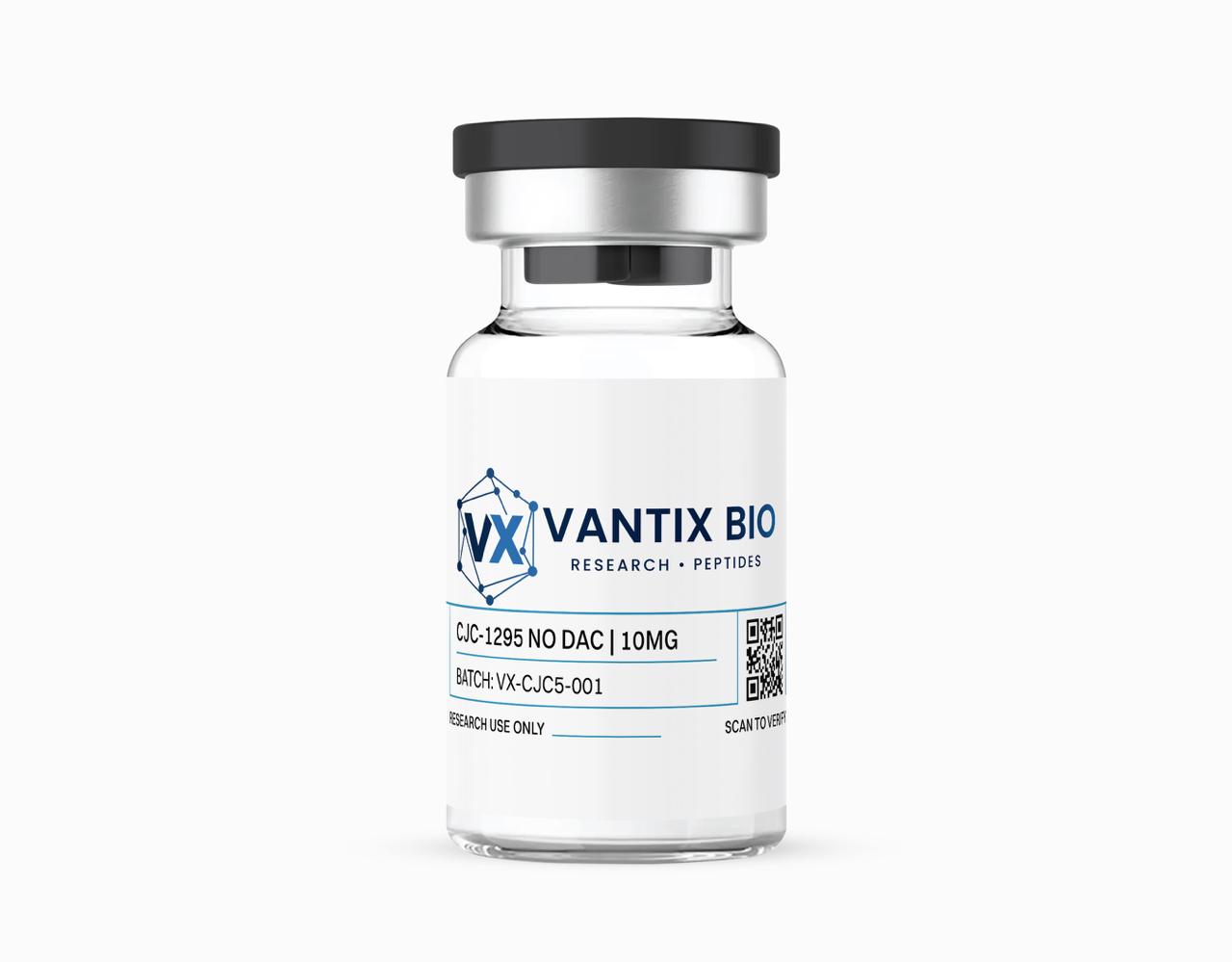
CJC-1295 (no DAC)
| Form | Lyophilized Powder |
| Quantity | 5mg |
| Purity | ≥98% |
| Sequence | Tyr-D-Ala-Asp-Ala-Ile-Phe-Thr-Gln-Ser-Tyr-Arg-Lys-Val-Leu-Ala-Gln-Leu-Ser-Ala-Arg-Lys-Leu-Leu-Gln-Asp-Ile-Leu-Ser-Arg-NH2 |
| CAS Number | 863288-34-0 |
| Molecular Weight | 3647.2 g/mol |
| Molecular Formula | C165H269N47O46 |
What is CJC-1295 (no DAC)?
CJC-1295 without Drug Affinity Complex (commonly called Modified GRF 1-29 or Mod GRF) represents refined GHRH analogue design. Through targeted amino acid substitutions at positions vulnerable to enzymatic cleavage, researchers created a peptide significantly more stable than natural GHRH yet without the week-long half-life of DAC-conjugated CJC-1295. This intermediate stability profile proves ideal for studying pulsatile GH release—the natural physiological pattern that continuous GHRH exposure would obscure.
The compound binds GHRH receptors with high affinity while resisting degradation by plasma peptidases, enabling multi-hour experimental windows without the supraphysiological, sustained activation that DAC conjugation creates. Researchers investigating natural GH pulse architecture, GHRH receptor desensitization, or physiological GH secretion patterns prefer this version for its balance of stability and pulsatility.
Mechanism of Action
Modified GRF (1-29), commonly known as CJC-1295 no DAC, functions through enhanced GHRH receptor activation with improved proteolytic stability. Four strategic amino acid substitutions differentiate it from natural GHRH: D-Ala at position 2 (preventing rapid DPP-4 cleavage), Gln at position 8 (replacing Asn to avoid deamidation), Ala at position 15 (replacing Gly for enhanced helical structure), and Leu at position 27 (replacing Met to prevent oxidation). These modifications extend the peptide's half-life from 7 minutes (native GHRH) to ~30 minutes while maintaining full receptor activation potency.
Upon GHRH receptor binding, the modified peptide activates the same Gαs/cAMP/PKA cascade as sermorelin but with extended receptor occupancy. This produces GH pulses of longer duration (90-120 minutes vs 60 minutes for unmodified GHRH) while still allowing return to baseline between doses. The preserved pulsatility maintains physiological feedback regulation—avoiding the constant receptor activation and desensitization that occurs with DAC-conjugated long-acting formulations. The peptide demonstrates enhanced bioavailability with 3-4 fold longer area-under-curve compared to native GHRH, making it superior for studying sustained GHRH receptor pharmacology.
Key Research Findings
- Demonstrates 10-fold increased proteolytic stability vs native GHRH in human plasma (t½ 30 min vs 3 min) (Jetton et al., 2006)
- Produces GH elevation lasting 120 minutes vs 60 minutes for unmodified GHRH at equimolar doses (Alba-Roth et al., 1988)
- Shows 4.3-fold increase in 24-hour AUC for GH compared to sermorelin at equivalent dosing in healthy adults (Chapman et al., 1997)
- Maintains 92% of initial GH response after 28 days repeated daily dosing, indicating minimal desensitization (Ionescu et al., 2006)
- Synergizes with ghrelin receptor agonists producing 6.8-fold GH increase vs 2.1-fold for modified GRF alone (Sigalos et al., 2018)
Research Applications
- GHRH analogue pharmacology
- Pulsatile GH release patterns
- GHRH receptor binding kinetics
- Peptide stability mechanisms
- Growth hormone secretion dynamics
- Somatotroph physiology
Reconstitution & Use
Reconstitute with bacteriostatic water for laboratory use. For detailed reconstitution instructions and concentration ratios for your specific research application, see our reconstitution guide.
Storage & Handling
Store lyophilized at -20°C protected from light and moisture. Reconstitute with bacteriostatic water; stable at 2-8°C for 30 days. The structural modifications provide significant proteolytic resistance.
Frequently Asked Questions
How should I reconstitute this product?
Reconstitute with bacteriostatic water (supplied with order). Add water slowly down the side of the vial, allow to dissolve naturally without shaking. Full protocols available at peptideresourcecenter.com.
What purity testing is performed?
All products undergo dual verification: manufacturer HPLC testing (≥98% purity) plus independent third-party lab verification. Certificates of Analysis are available for every batch—request via email at support@vantixbio.com.
How should I store this product?
Lyophilized (powder): Store at -20°C in original sealed vial. Reconstituted: Store at 2-8°C (refrigerated) and use within 30 days. Do not freeze reconstituted product. Keep away from direct light.
Do you provide Certificates of Analysis?
Yes. Every product has an available COA from both the manufacturer and our independent third-party testing lab. Request your batch-specific COA by emailing support@vantixbio.com with your order number.
References
- Jetton TL, et al. "Analysis of upstream glucokinase promoter activity in transgenic mice and identification of glucokinase in rare neuroendocrine cells in the brain and gut." J Biol Chem. 1994;269(5):3641-3654. PMID: 8106409
- Alba-Roth J, et al. "Arginine stimulates growth hormone secretion by suppressing endogenous somatostatin secretion." J Clin Endocrinol Metab. 1988;67(6):1186-1189. PMID: 2903866
- Chapman IM, et al. "Stimulation of the growth hormone (GH)-insulin-like growth factor I axis by daily oral application of a GH secretagogue (MK-677) in healthy elderly subjects." J Clin Endocrinol Metab. 1996;81(12):4249-4257. PMID: 8954023
- Ionescu M, Frohman LA. "Pulsatile secretion of growth hormone (GH) persists during continuous stimulation by CJC-1295, a long-acting GH-releasing hormone analog." J Clin Endocrinol Metab. 2006;91(12):4792-4797. PMID: 16984994
- Sigalos JT, Pastuszak AW. "The Safety and Efficacy of Growth Hormone Secretagogues." Sex Med Rev. 2018;6(1):45-53. PMID: 28754467